Senin, 09 November 2009

Should the Brewers Sign John Lackey?

I'm skeptical, but Buster Olney is more optomisitic than I:
"Remember, it was only a year ago when Milwaukee offered CC Sabathia a $100 million deal, so the Brewers clearly are prepared to pay big dollars for a big-time starting pitcher. And they have a clear need: Even with rising star Yovani Gallardo anchoring the staff, Milwaukee ranked dead last in starters' ERA at 5.37 and 27th in rotation innings this past season.

The Brewers conceivably could enter into trade conversations for Vazquez or Halladay, but this course would be problematic. Milwaukee traded aggressively in 2007 and 2008, most notably for Sabathia, and this depleted its farm system. Trading a top young player for a one-year rental like Vazquez or Halladay might not make sense

It probably would make more sense for the Brewers to take a serious run at Lackey, who as a free agent would not cost them talent in trade. He would take pressure off Gallardo and fit their team culture.

The Brewers also could easily structure a Lackey deal to fit their payroll into the future. Jeff Suppan's contract will expire after next season, and the only real long-term obligation the Brewers have set in stone is to young slugger Ryan Braun, who is signed through the 2015 season. Milwaukee just reduced salary obligations by trading J.J. Hardy to the Twins and replacing Mike Cameron (who made $10 million last season) with Carlos Gomez."
There's no doubt that if the Brewers add Lackey, then this team would become one of the favorites in the NL Central. A rotation led by Lackey and Yovani Gallardo would be one of the best 1-2 combos in baseball.

But before getting all giddy at the thought of Lackey joining the Brewers, ask yourself this: should a team with a $80 million dollar payroll commit more than 15% of their total payroll for the next 4-6 years to a 31 year old starting pitcher for with a history of arm problems? That doesn't seem like a risk that I would be willing to take.

Furthermore, if the Brewers sign Lackey, that would just about eliminate the possibility of the Brewers retaining Prince Fielder long term. Fielder is certain to command a contract worth $15-$20 million dollars annually, which would make it almost impossible for the Brewers to retain him, unless they felt comfortable spending between 40-50% of their total payroll on two players. At this stage in the game, are the Brewers prepared to give themselves no chance to resign Fielder?

Of course, if the Brewers plan on trading Fielder, then they could conceivably sign Lackey and not have to worry about a possible payroll logjam. But once again, ask yourself, is John Lackey worth the risk for the Brewers?

I understand that the Brewers need to take advantage of the limited window they have right now to compete, but Lackey is too expensive, requires too much of a commitment, restricts their payroll flexibility, and ultimately, is not worth the risk for the Brewers, who unfortunately do not have an exorbitant payroll.

Thoughts?

****** ******

(Jorge Says No! on Facebook)

(Follow Jorge Says No! on Twitter)

Did the Twins Make a Mistake by Picking Up Michael Cuddyer's Option?

$10.5 million for Michael Cuddyer in 2011! Rob Neyer is not a fan:
"Cuddyer is a good hitter but a subpar outfielder, resulting in a player who is, at his best, worth less than $10 million. Granted, considering the $1 million buyout, the Twins essentially have committed to spending $9.5 million on Cuddyer in 2011. And $9.5 million isn't much more than what he was worth this year, and in 2007 (2008 was a disaster).

Of course the problem is that Cuddyer has entered his decline phase. He'll turn 31 next spring and (more to the point) 32 in 2011. He might be just as good in 2011 as he was in 2009 ... but we know that he probably won't be. We know that instead of being a (roughly) $9 million player, as he was this year, he's more likely to be an $8 million player or a $7 million player.

No, the difference between Cuddyer's salary and his value is not a great deal of money. But the Twins have a history of overspending on decent players while complaining about the high price of truly great players. Remember, it was just a year ago that they couldn't afford Johan Santana but quite happily blew $9 million on Craig Monroe and Livan Hernandez. And if they're not able to keep Justin Morneau and Joe Mauer in the long term, their money mismanagement is simply going to drop them from contention."
I dunno if I would call this money mismanagement. Sure $10.5 million might be slightly excessive for Michael Cuddyer, but I don't mind this move at all for the Twins. As long as their payroll jumps as expected into the $80-$90 million dollar range, then spending $10.5 million on Michael Cuddyer is not a horrible move. If the Twins' payroll was closer to $60 million, then I would completely understand Neyer's frustration with the Twins, but these are different times for the Twins. Instead of operating like a small market franchise, the Twins should (and hopefully will) have a more aggressive approach and take advantage of their new resources.

What I find strange about Neyer's response is his last sentence about the futures of Joe Mauer and Justin Morneau. The Twins actually do have Justin Morneau locked up long term-he is signed through 2013-a move that was praised throughout baseball. And even though Joe Mauer is a free agent to be after the 2010 season, the odds are high that he will remain with the Twins and it should be taken as a good sign that the Twins want to surround Mauer with quality talent. Hopefully with their new resources, the Twins will not have a problem locking up Joe Mauer to a long term contract similar to the one that Justin Morneau signed a few years back.

And finally, I'd to see any evidence that Neyer has that Cuddyer is currently on the decline. I understand that as players get older, they generally decline, but Cuddyer's numbers this season do not present any evidence that he will decline in the near future. Picking up Cuddyer's option is a good risk for the Twins to take and if you need any evidence of that, just look at Cuddyer's stats in 2007 and 2009.

Thoughts?

****** ******

(Jorge Says No! on Facebook)

(Follow Jorge Says No! on Twitter)

Jumat, 06 November 2009

Twins Acquire JJ Hardy

It didn't take long for the Brewers to make the trade everybody saw coming.
"The ticker tape was still falling in Manhattan on Friday when the Brewers dealt shortstop J.J. Hardy, a staple of trade rumors this year, to the Twins for speedy center fielder Carlos Gomez. The Brewers announced the trade on their official Twitter feed."
From the Twins' perspective, this trade is a major boon. Before acquiring Orlando Cabrera from the A's last July, the Twins struggled to find a capable starting shortstop, who could give them some production at the dish. Even though Hardy struggled in 2009, you have to remember that in the two seasons prior, Hardy hit 26 and 24 home runs respectively, which made Hardy one of the best hitting shortstops in baseball. This is a good risk for the Twins, who needed to add some impact right handed hitters to their lineup. This acquisition also means that Orlando Cabrera will not be returning to the Twins in 2010.

In addition, it will be interesting to see what this deal means for the Twins' payroll. With a new ballpark opening up in 2010, the Twins budget has been rumored to be on the rise for sometime now. By acquiring JJ Hardy, the Twins will be adding around $4 million in salary, but could it signal a more aggressive approach to free agency?

From the Brewers' perspective, moving Hardy became a necessity. With Alcides Escobar entrenched at short, there was no way that the Brewers could justify paying Hardy around $5 million next season to be a bench player. The Brewers' payroll simply does not give the team that luxury and most baseball people presumed that Hardy would be on the move this winter.

The acquisition of Carlos Gomez is a shrewd move by GM Doug Melvin. Gomez is still young and raw, but he has fantastic tools and is one of the fastest players in baseball today. But Gomez gives GM Doug Melvin tons of options moving forward this offseason. Because of the Gomez acquisition, the Brewers are likely to let free agent center fielder Mike Cameron walk, which should free up roughly $10 million dollars for Melvin to spend on starting pitching.

Overall, this trade has the potential to be a win-win for both sides.

Thoughts?

****** ******

(Jorge Says No! on Facebook)

(Follow Jorge Says No! on Twitter)
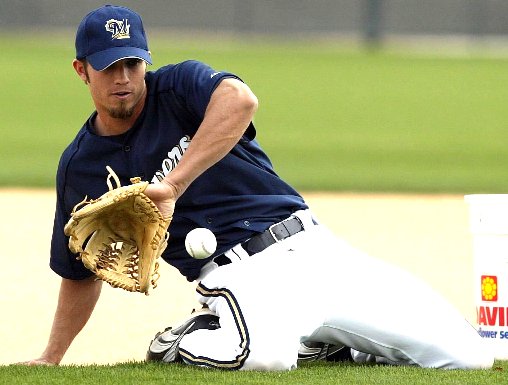
Jeremy Hermida: Classic Theo Epstein

Last offseason, GM Theo Epstein opted against making a big splash in free agency and instead decided to make a number of "low risk, high reward" signings. Epstein went out and signed John Smoltz, Brad Penny, Takashi Saito, and Rocco Baldelli to 1 year contracts with plenty of incentives. All of those players were coming off injury plagued seasons, but their history suggested that if they were healthy, they could be productive and help the Red Sox.

However, the plan did not work out. The only signing that truly panned out for the Red Sox was Takashi Saito. Penny and Smoltz struggled with the Red Sox and failed to complete the season with the team and Baldelli was nothing more than a average hitter and never really made a big impact with the Red Sox.

Most teams can't afford to go 1 of 4 on free agent signings. However, the Red Sox are not like most teams. The Sox have the second highest payroll in baseball and they can afford to take risks on free agents. The Red Sox spent almost $12 million dollars on Smoltz, Baldelli, and Penny; which is not even 10% of the teams' total payroll.

This offseason, it looks like the Red Sox are taking a very similar approach. Yesterday, the Sox acquired OF Jeremy Hermida from the Marlins for two prospects. Hermida was one of the Marlins top prospects a few years back, but has never fully figured it out at the major league level. The Marlins were likely to non tender Hermida this offseason because Hermida was arbitration eligible and likely to get a nice raise that would make him too expensive for the frugal Marlins.

But for the Red Sox, acquiring Hermida was a risk they could afford to take. While $4 million dollars is a lot for the Marlins to pay the struggling outfielder, the Red Sox could afford to take a chance on Hermida, hoping that he discovers his ability in the majors. The Red Sox $140 million+ payroll gives them the flexibility to take risks.

This is another example of a "low risk, high reward" deal for the Red Sox. If Hermida pans out, then the Red Sox have a starting OF under team control for the next few years, but if Hermida continues to struggle, then the Red Sox can simply not offer him arbitration next year and cut their minimal losses.

Thoughts?

****** ******

(Jorge Says No! on Facebook)

(Follow Jorge Says No! on Twitter)

Hypothetically Speaking: The Josh Johnson Contract Extension

Will the Marlins sign Josh Johnson to a contract extension? MLB.com's Joe Friscaro sure thinks so:
"I think the Marlins will sign Josh Johnson to a long-term deal. As hard as it was to see Beckett and Mike Lowell get traded, the Marlins received Hanley Ramirez in return. Ramirez is among the top five players in the game, so trading Beckett ended up being a good deal. The jury is still out on the Cabrera trade. But in your question, which I shortened for space reasons, you also mentioned you wanted Dontrelle Willis signed to a long-term deal. Had the Marlins done that, considering all the struggles Willis has gone through, it wouldn't have been a wise decision."
What would it take for the Marlins to keep Josh Johnson long term? Let's take a look at what each side would need to make Johnson a Marlin for the foreseeable future.

The Marlins

1. Buyout the two remaining years of arbitration

2. Buyout at least two years of Johnson's free agent seasons

3. Reasonable salary that increases as the Marlins payroll is set to increase

The Josh Johnson Camp

1. Financial Security

2. Eventually become one of the highest paid pitchers (annually) in the NL

So how about this deal for Johnson and the Marlins?

(4 years/$40 million)

Here is the contractual breakdown:

2010: $4 million
2011: $8 million
2012: $13 million
2013: $15 million

Why it works for the Marlins:

1. Buyout 2 years of arbitration

2. Buyout 2 years of free agency

3. Backloaded deal that corresponds to the opening of Marlins' new stadium, which should lead to an increased payroll

Why it works for Johnson:


1. Financial Security

2. Become a free agent at age 29 after the 2013 season

If the Marlins let Johnson become a free agent after the 2011 season, there is a very high possibility that he could become one of the highest paid pitchers in baseball history. Granted, that statement is contingent on Johnson staying healthy and dominant for the next two seasons, but he definitely has the ability to do so.

Thoughts?

****** ******

(Jorge Says No! on Facebook)

(Follow Jorge Says No! on Twitter)

Kamis, 05 November 2009

What Should the Nationals Do this Offseason?

As Alden Gonzalez notes, the Nationals will have some payroll flexibility this offseason. Rejoice!?
"The day after the end of the World Series marks the unofficial beginning of the offseason and the official start of free agency, which means it's decision time for Major League clubs. For the Nationals, it also means one very important thing: a little contractual freedom.

Beginning Thursday, players with expiring contracts and at least six years of Major League service time have a 15-day window to file for free agency. During that time, the team that player ended the 2009 season with has exclusive negotiation rights. After that, they are free to sign with any team.

For the Nationals, that means the $10 million Dmitri Young made in two injury-riddled seasons will be off the books, and so will the $10 million club option for Austin Kearns they almost certainly won't pick up -- instead opting for the $1 million buyout."
According to Cot's Baseball Contracts, the Nationals only have roughly $28 million committed in player salaries right now, which of course is before arbitration. It remains to be seen what the Nationals' budget will be for 2010, but I imagine that the number will be somewhere in the $50-$60 million dollar range.

If that's the case, then could the Nationals make an impact on the free agent market? Maybe, but doubtful. The last thing I would expect the Nationals to do is to spend a boatload on any one free agent, but if Adam Dunn showed us anything last year, we shouldn't count out the Nats just yet, especially given how many decent free agents there could be this offseason.

With that said, the Nationals need to address their glaring needs in the starting rotation and in the bullpen. I understand that the Nationals are building for the future through the draft, but there is only so many 100+ loss teams that Nationals fans will be able to stomach before they are completely turned off to the team. The Nationals need to show the city some improvement in 2010 if they want to begin to establish a fan base and a legacy of winning.

In addition, there are a few things the Nationals need to do before diving into the free agent market:

1. Extension for Josh Willingham?

2. What to do with Scott Olson?

Finally, I'd love to see the Nationals take a chance on a pitcher like Todd Wellemeyer or Brett Myers, two pitchers who have injury concerns, won't be terribly expensive, would not cost the Nationals draft picks, and have high upside.

Any other suggestions?

****** ******

(Jorge Says No! on Facebook)

(Follow Jorge Says No! on Twitter)

Mark Teahen to the White Sox: Where's the Upside?

Are the trade winds 'brewin in Chicago? You be the judge:
"While the Yankees and Phillies continued to wage their World Series battle Wednesday night, the Chicago White Sox and Kansas City Royals were making a trade.

The Daily News learned the White Sox have agreed to send second baseman Chris Getz and third baseman Josh Fields to the Royals for Mark Teahen, who is expected to replace Jermaine Dye as Chicago's right fielder.

Teahen hit .271 with 12 homers and 50 RBI for the Royals in '09, but in 77 games lifetime against the White Sox he has batted .277 with 12 homers and 41 RBI, which may explain why they wanted him on their side."
There is one word that comes to mind when talking about this trade: upside.

From the Royals perspective, there is plenty of upside in this deal. GM Dayton Moore traded away a mediocre player with a rising price tag for two inexpensive players, who are under team control for the foreseeable future and actually have some talent. Chris Getz was the White Sox starting second baseman this season and has a lifetime OBP in the minors of .380. And it was just a few years ago that Josh Fields was one of the White Sox best prospects and remember that in 2007, Fields hit 23 home runs for the White Sox.

However, I'm struggling to comprehend where White Sox GM Kenny Williams sees the upside in this deal for his team. At this stage in his career, Mark Teahen is what he is: a mediocre hitter with some pop, who can play a average right field. Teahen has never developed in the OBP force that he was projected to become and his batting average has been on the decline since 2006. In addition, Teahen does not seem to be an adequate fit to replace Jermaine Dye's bat in right field, even though his defense is vastly superior to Dye's. And finally, Teahen will probably earn more than $4 million dollars in arbitration this season, which would actually make him a candidate to be non tendered. According to fangraphs, Teahen has not been worth more than $1.3 million in either of the past two seasons.

So until something official comes down, I have a tough time believing this deal as constructed. This deal would seem to greatly benefit the Royals, but it does not look like a high upside trade that Kenny Williams would typically make.

Thoughts?

****** ******

(Jorge Says No! on Facebook)

(Follow Jorge Says No! on Twitter)